SCC Infrastructure Pvt Ltd Vacancy | For civil and infrastructure projects
Company Name
SCC Infrastructure Pvt. Ltd.
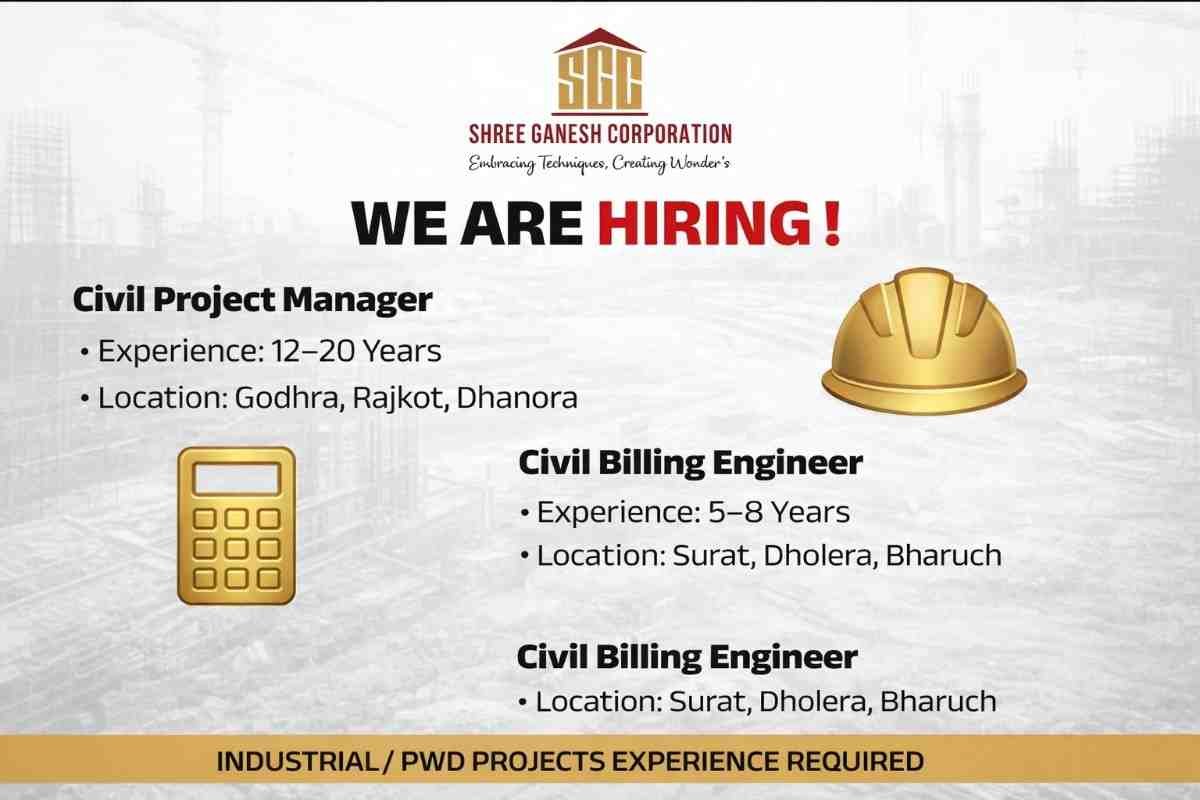
SCC Infrastructure Pvt. Ltd. is a growing infrastructure and construction company in India, actively involved in multiple civil and infrastructure projects. The company focuses on quality execution, engineering excellence, and sustainable development, and continues to expand its project footprint across Gujarat.
To strengthen its project teams, SCC Infrastructure Pvt. Ltd. is inviting applications from experienced professionals for the following positions.
Open Positions & Experience Requirements
1. QS Engineer
- Experience Required: 5 to 10 Years
2. QA/QC Engineer
- Experience Required: 6 to 12 Years
3. Site Accountant
- Experience Required: 3 to 6 Years
4. Billing Engineer
- Experience Required: 4 to 8 Years
5. Surveyor
- Experience Required: 3 to 6 Years
Job Locations
- Ahmedabad
- Surat
- Vapi
- Billimora
- Bharuch
Candidates should be willing to work at project sites as per organizational requirements.
How to Apply
Interested and eligible candidates are requested to send their updated resume to the official email ID:
Email: careers@sccinfrastructure.com
Please mention the position name in the subject line of your email.
Frequently Asked Questions (FAQ)
Q1. Are these positions site-based?
Yes, all positions are primarily site-based roles at various project locations in Gujarat.
Q2. Is relevant experience mandatory for all roles?
Yes, relevant experience as mentioned for each position is mandatory.
Q3. Can candidates from outside Gujarat apply?
Yes, candidates from other locations may apply, provided they are willing to relocate to project sites in Gujarat.
Q4. Are freshers eligible for these positions?
No, this hiring drive is for experienced professionals only.
Q5. Will shortlisted candidates be contacted directly?
Yes, only shortlisted candidates will be contacted by the HR team for further discussion and interviews.
Workplace Safety in Construction: Accident Insurance Benefits and Claim Process
Introduction
The construction industry is one of the most hazardous workplaces in the world. Construction workers face daily risks such as falls from heights, heavy machinery accidents, electrocution, exposure to hazardous materials, and structural failures. Despite advances in technology and safety regulations, accidents remain common due to the nature of construction work. In this environment, workplace safety and accident insurance are essential safeguards that protect workers’ lives, livelihoods, and dignity.
Accident insurance plays a crucial role in ensuring that when safety measures fail or unforeseen incidents occur, workers and their families are not left without financial and social support. It complements workplace safety efforts by offering compensation and stability during times of crisis.
Importance of Workplace Safety in Construction
Workplace safety is the foundation of responsible construction practices. Employers are expected to provide safe working conditions through proper training, protective equipment, and strict adherence to safety standards. Measures such as safety harnesses, helmets, machinery guards, and regular site inspections significantly reduce the likelihood of accidents.
However, construction sites are dynamic and unpredictable. Changing work conditions, tight project deadlines, and human error can still lead to serious injuries. This reality makes accident insurance a necessary backup system that protects workers when preventive measures are not enough.
What Is Accident Insurance in Construction?
Accident insurance is a specialized insurance policy designed to provide financial compensation in the event of work-related injury, disability, or accidental death. Unlike general health insurance, accident insurance specifically addresses occupational hazards and their long-term impact on a worker’s income and family security.
In the construction sector, accident insurance is often employer-provided or mandated by labor laws. Its purpose is to ensure that workers do not bear the financial burden of workplace risks alone.
Key Benefits of Accident Insurance for Construction Workers
Financial Protection for Families
In cases of accidental death, accident insurance provides a lump-sum payout to the worker’s nominated beneficiary. This compensation helps families manage daily expenses, repay debts, and maintain basic living standards during an extremely difficult time.
Coverage for Permanent and Partial Disability
Construction accidents can result in loss of limbs, reduced mobility, or permanent impairment. Accident insurance offers compensation based on the extent of disability, helping injured workers adapt to their new circumstances and maintain financial independence.
Medical and Hospitalization Support
Many accident insurance policies cover medical expenses related to workplace injuries, including hospitalization, surgery, and rehabilitation. This reduces out-of-pocket costs and ensures access to proper treatment.
Income Support During Recovery
Temporary disability benefits replace a portion of lost wages while the worker is recovering. This income support prevents financial instability and allows workers to focus on recovery without economic pressure.
Encouragement of Safer Work Practices
When accident insurance is mandatory, employers become more accountable for safety. This often leads to better training programs, improved safety equipment, and a stronger safety culture on construction sites.
Accident Insurance Claim Process in Construction
Understanding the claim process is critical to ensuring timely compensation.
Step 1: Immediate Accident Reporting
The accident should be reported to the site supervisor or employer as soon as it occurs. Prompt reporting establishes the authenticity of the incident and avoids unnecessary delays.
Step 2: Medical Treatment and Documentation
The injured worker must seek immediate medical attention. Medical records should clearly state the nature of the injury and confirm that it resulted from a workplace accident.
Step 3: Notification to the Insurance Provider
The employer or policyholder must inform the insurance company within the time limit specified in the policy terms.
Step 4: Submission of Required Documents
Common documents include:
- Completed claim form
- Accident or incident report
- Medical records and bills
- Proof of employment
- Identity proof
- Post-mortem report in fatal cases
Step 5: Claim Verification and Assessment
The insurance company reviews all documents and may conduct medical evaluations, especially in cases involving permanent disability.
Step 6: Claim Settlement
Once verified and approved, the compensation amount is paid directly to the worker or their nominated beneficiary.
Challenges Faced by Construction Workers
Despite the availability of accident insurance, many workers face challenges such as lack of awareness, informal employment, delayed reporting, and documentation issues. Migrant and contract workers are particularly vulnerable to being excluded from insurance benefits.
Addressing these challenges requires stronger enforcement of labor laws, simplified claim procedures, and awareness programs to educate workers about their rights and entitlements.
Conclusion
Workplace safety in construction is a shared responsibility between employers, workers, and regulators. While preventive safety measures reduce risks, accident insurance provides essential protection when accidents occur. It ensures financial security, medical support, and dignity for construction workers and their families.
A construction industry that prioritizes both safety and accident insurance not only protects workers but also promotes ethical practices, social responsibility, and sustainable development. Investing in worker protection is ultimately an investment in human lives and long-term progress.