KRYFS New Job Opening 2026 | For Tanks & Railways manufacturing
Company Name
KRYFS
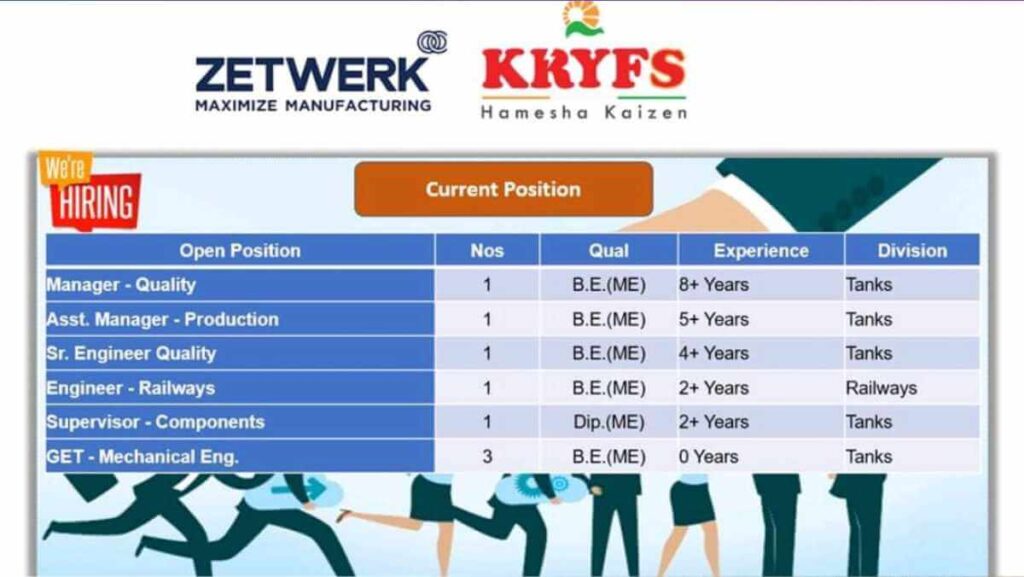
ZETWERK through its group company KRYFS is inviting skilled and passionate mechanical professionals to join its growing manufacturing operations. If you are looking to build a strong career in Tanks & Railways manufacturing, this is your opportunity.
KRYFS Job Vacancy 2026
Current Open Positions
1. Manager – Quality
- Openings: 1
- Qualification: B.E. – Mechanical
- Experience: 8+ Years
- Division: Tanks
2. Assistant Manager – Production
- Openings: 1
- Qualification: B.E. – Mechanical
- Experience: 5+ Years
- Division: Tanks
3. Senior Engineer – Quality
- Openings: 1
- Qualification: B.E. – Mechanical
- Experience: 4+ Years
- Division: Tanks
4. Engineer – Railways
- Openings: 1
- Qualification: B.E. – Mechanical
- Experience: 2+ Years
- Division: Railways
5. Supervisor – Components
- Openings: 1
- Qualification: Diploma – Mechanical
- Experience: 2+ Years
- Division: Tanks
6. GET – Mechanical Engineer
- Openings: 3
- Qualification: B.E. – Mechanical
- Experience: Fresher (0 Years)
- Division: Tanks
How to Apply
Interested candidates may send their resumes to:
- nierbhay.mishra@kryfs.com
- hr@kryfs.com
| nierbhay.mishra@kryfs.com | |
| hr@kryfs.com |
Frequently Asked Questions (FAQs)
Q1. Who can apply for these roles?
Candidates with Mechanical Engineering qualifications and relevant experience in manufacturing, fabrication, tanks, or railways can apply. Freshers are welcome for GET roles.
Q2. Are freshers eligible?
Yes, GET – Mechanical Engineer positions are open for fresh B.E. Mechanical graduates.
Q3. Which divisions are hiring?
Hiring is for Tanks Manufacturing and Railways Division.
Q4. Is prior manufacturing experience mandatory?
Yes, for experienced roles. However, freshers can apply for GET positions.
Q5. What type of work culture can I expect?
ZETWERK & KRYFS follow a Kaizen-driven culture focused on quality, efficiency, and continuous improvement.
Q6. Is this a site role or factory-based role?
These are primarily manufacturing / plant-based roles under Tanks and Railways divisions.
Q7. How many vacancies are open in total?
A total of 8 positions are currently open across various roles.
Q8. Will shortlisted candidates be contacted?
Yes, only shortlisted candidates will be contacted by the HR team for further steps.
Construction Workers’ Accident Insurance: Benefits, Coverage, and Claim Procedure
A Human Rights–Based Approach to Worker Safety and Social Protection
Introduction
The construction industry is widely recognized as one of the most dangerous sectors of employment. Construction workers routinely face risks such as falls from heights, machinery-related injuries, electrocution, and structural failures. Despite contributing significantly to national development and infrastructure growth, many construction workers operate without adequate social protection. In this context, accident insurance for construction workers is not merely a financial arrangement—it is a fundamental human right that safeguards life, dignity, and economic security.
Construction Workers and Human Rights
Human rights principles affirm that every individual has the right to life, safe working conditions, and social security. International labor standards emphasize that workers exposed to hazardous environments must be protected against occupational injuries and accidents. Construction workers, particularly migrant and contractual laborers, often fall outside formal safety nets, making them more vulnerable to exploitation and poverty.
Accident insurance plays a critical role in upholding these rights by ensuring that workers and their families are not left unprotected when accidents occur. Providing accident insurance reflects social responsibility and respect for human dignity.
Understanding Accident Insurance for Construction Workers
Accident insurance is a specialized insurance policy that offers financial compensation in cases of workplace injury, permanent or partial disability, or accidental death. Unlike general health insurance, accident insurance focuses specifically on risks arising from employment-related activities.
Such insurance may be provided by employers, mandated by governments, or obtained individually by workers. Its primary objective is to protect workers and their dependents from sudden financial distress resulting from workplace accidents.
Key Benefits of Accident Insurance
Financial Security for Families
In the event of accidental death, accident insurance provides a lump-sum compensation to the worker’s nominee or family members. This support helps families meet essential expenses such as food, education, healthcare, and housing.
Compensation for Permanent and Partial Disability
Construction accidents often lead to serious, life-altering injuries. Accident insurance offers compensation based on the severity of disability, enabling workers to maintain a basic standard of living and personal dignity.
Medical and Hospitalization Support
Many accident insurance policies cover medical treatment, hospitalization, surgery, and rehabilitation costs directly related to workplace injuries, reducing the financial burden on workers.
Income Replacement During Recovery
Temporary disability benefits provide income support during the recovery period, preventing wage loss and financial instability.
Promotion of Safer Work Environments
When accident insurance is mandatory, employers are more likely to implement and maintain safety standards, contributing to a safer workplace culture.
Accident Insurance Claim Process
Understanding the claim process is essential to ensure timely and fair compensation.
Step 1: Immediate Accident Reporting
The worker or supervisor must report the accident to the employer as soon as possible. Prompt reporting helps establish the authenticity of the claim.
Step 2: Medical Examination and Documentation
The injured worker should seek immediate medical attention. Medical reports must clearly state the nature of injury and confirm that it resulted from a workplace accident.
Step 3: Notification to the Insurance Provider
The employer or policyholder must inform the insurance company within the time frame specified in the policy terms.
Step 4: Submission of Claim Documents
Commonly required documents include:
- Completed claim form
- Accident report
- Medical records and bills
- Proof of employment
- Identity proof
- Post-mortem report in fatal cases
Step 5: Claim Verification
The insurance provider verifies submitted documents and may conduct medical assessments in disability-related claims.
Step 6: Claim Settlement
Once the claim is approved, compensation is disbursed to the worker or their nominated beneficiary.
Challenges Faced by Construction Workers
Despite existing insurance frameworks, many construction workers face barriers such as:
- Lack of awareness about insurance rights
- Informal employment arrangements
- Delayed reporting by contractors
- Documentation and literacy challenges
These issues underscore the need for stronger enforcement mechanisms and worker education programs.
Strengthening Accident Insurance as a Human Right
Accident insurance must be treated as a mandatory right rather than a voluntary benefit. Governments should enforce compulsory coverage, employers must ensure compliance, and workers should be educated about their entitlements. Simplified claim procedures and transparent settlement systems are essential to ensure justice and equity.
Conclusion:
Accident insurance for construction workers is a critical instrument of social protection and human rights. It ensures that workers who risk their lives to build infrastructure are not abandoned in times of crisis. By strengthening accident insurance coverage and awareness, societies can promote dignity, fairness, and sustainable development while honoring the rights of construction workers.