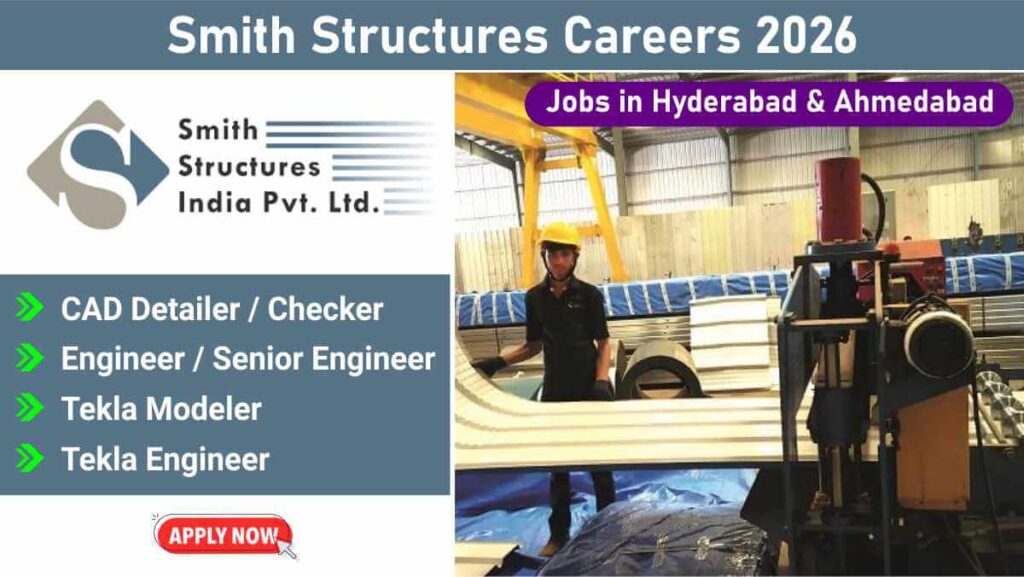
Smith Structures India Pvt Ltd Vacancy | High Quality Steel Building Systems across India
Company Name
Smith Structures (India) Pvt. Ltd.
Smith Structures (India) Pvt. Ltd. is a leading Prefab & PEB solutions provider, delivering high-quality steel building systems across India. With a strong engineering backbone, advanced detailing capabilities, and a commitment to quality, Smith Structures offers a professional work environment and long-term career growth.
Smith Structures Careers 2026
Current Open Positions
1. CAD Detailer / Checker
- Experience: 3–7 Years
- Location: Hyderabad
- Education: B.E. / B.Tech – Civil or Mechanical
- Software: AutoCAD
Role Overview:
- CAD Detailer: Preparation of 2D approval drawings, Anchor Bolt drawings, GA drawings, and Sheeting Detailing for PEB projects.
- Checker: Checking of 2D approval drawings, Anchor Bolt drawings, GA drawings, and Sheeting Detailing.
Key Responsibilities:
- Coordinate with Design Team and Team Lead
- Prepare accurate 2D drawings as per project specifications
- Ensure drawings meet company standards
- Expert-level proficiency in AutoCAD is mandatory
2. Engineer / Senior Engineer – Detailing / Modelling (Tekla)
Experience:
- Tekla Detailer: 2–3 Years
- Tekla Modeller: 5–7 Years
Location: Hyderabad
Education: B.E. / B.Tech – Civil or Mechanical
Software: Tekla, AutoCAD
Key Responsibilities:
- Tekla detailing and modelling for PEB projects
- Strong understanding of PEB structures and detailing workflow
- Coordination with Tekla Modellers / Checkers
- Expert-level proficiency in Tekla Structures
3. Tekla Modeler
- Experience: 2–4 Years
- Location: Ahmedabad, Gujarat
- Department: Engineering
- Employment Type: Full Time | Permanent
- Education: B.E. / B.Tech – Civil
- Software: Tekla, AutoCAD
Job Responsibilities:
- Preparation of TEKLA models for PEB / Structural Steel Buildings
- Create GA, Erection, Shop drawings & BOM
- Develop drawings as per PIS, design, and approved drawings
- Coordinate with Design Engineer, Checker, and Manager
How to Apply
- Apply Link: Click Here
Email your Resume:
- recruitment@smithstructure.com
- info@smithstructure.com
Contact Person:
Mr. Niraj Maliwar – +91 92740 02941
Website: https://www.smithstructure.com/
| Apply Link | Click Here |
| recruitment@smithstructure.com | |
| info@smithstructure.com |
Frequently Asked Questions (FAQs)
Q1. Is PEB / Steel Structure experience mandatory?
Yes, PEB or steel structure experience is compulsory for all roles.
Q2. Are diploma holders eligible?
No, B.Tech / BE (Civil or Mechanical) is mandatory.
Q3. Is Tekla experience compulsory for Tekla roles?
Yes, hands-on Tekla Structures experience is required.
Q4. Are these permanent positions?
Yes, all roles are full-time & permanent.
Q5. Is relocation required?
Yes, candidates must be willing to work at Hyderabad or Ahmedabad, as applicable.
Q6. Is AutoCAD mandatory for CAD roles?
Yes, expert-level AutoCAD proficiency is essential.
Q7. Will freshers be considered?
No, minimum experience criteria must be met.
Q8. How will shortlisted candidates be contacted?
Shortlisted candidates will be contacted via email or phone.
Employee Safety, Health Insurance & Accident Coverage
Introduction
A safe and healthy workplace is not a privilege—it is a fundamental human right. Every employee, regardless of job role or industry, has the right to work in conditions that protect life, health, and dignity. However, across many sectors, employees continue to face unsafe working environments, inadequate medical support, and lack of financial protection in case of accidents. Employee safety, health insurance, and accident coverage are essential pillars of human rights at work, ensuring that economic development does not come at the cost of human lives.
Employee Safety as a Human Right
The right to life and personal security forms the foundation of all labor rights. Workplace safety is directly linked to this right. Employers have a moral and legal duty to provide safe machinery, proper training, protective equipment, and risk-free working conditions.
When safety measures are ignored, employees are exposed to preventable injuries, disabilities, and even death. From a human rights perspective, unsafe workplaces amount to neglect of basic dignity. Ensuring employee safety is not only about compliance with laws—it is about respecting the value of human life.
Health Insurance: Protection Beyond the Workplace
Health insurance is a vital component of employee well-being. It ensures access to timely medical care, preventive health services, and financial relief during illness. Without health insurance, even minor health issues can turn into major financial crises, especially for low- and middle-income employees.
From a human rights standpoint, health insurance supports the right to health. It allows employees to seek treatment without fear of losing wages or falling into debt. Comprehensive health insurance also improves productivity, mental well-being, and overall quality of life.
Accident Coverage and Social Security
Workplace accidents can happen even in well-regulated environments. Accident coverage provides financial compensation in cases of injury, disability, or death resulting from work-related incidents. This coverage ensures that employees and their families are not pushed into poverty due to sudden loss of income.
Accident insurance reflects the right to social security, a core human right recognized globally. It acknowledges that employees should not bear the consequences of occupational risks alone. By offering accident coverage, employers share responsibility for workplace hazards.
Impact on Employees and Their Families
The absence of safety measures, health insurance, and accident coverage affects not only employees but also their families. An injured or ill employee often becomes unable to support dependents, leading to emotional stress, financial hardship, and social exclusion.
Human rights demand protection not just for workers but also for those who depend on them. Insurance coverage and safety systems help families maintain stability during crises and prevent intergenerational poverty.
Challenges in Realizing Employee Rights
Despite legal frameworks, many employees still lack adequate protection due to:
- Informal employment arrangements
- Lack of awareness about rights and benefits
- Weak enforcement of labor laws
- Cost-cutting by employers
Migrant workers, contract laborers, and gig workers are particularly vulnerable. Addressing these challenges requires collective action by governments, employers, and civil society.
Employer Responsibility and Ethical Leadership
Ethical employers recognize that investing in safety and insurance is not a burden but a responsibility. Providing safety training, health coverage, and accident insurance builds trust, loyalty, and long-term sustainability.
From a human rights lens, responsible employers act as guardians of employee dignity. Their commitment to safety and insurance reflects respect for equality, fairness, and justice in the workplace.
The Way Forward: Rights-Based Workplace Protection
To strengthen employee safety and insurance systems, the following steps are essential:
- Mandatory safety audits and training
- Universal health insurance coverage for employees
- Compulsory accident insurance across industries
- Transparent and simplified claim processes
- Awareness programs on employee rights
Such measures ensure that economic growth aligns with human dignity and social justice.
Conclusion
Employee safety, health insurance, and accident coverage are not optional benefits—they are fundamental human rights. Protecting employees from workplace risks and financial distress reflects a society’s commitment to justice, equality, and human dignity. A truly progressive workplace is one where every employee feels safe, supported, and valued—not just as a worker, but as a human being.